GG25 or GG30: Which Grey Iron Class for a Machine Bed
GG25 and GG30 differ in tensile strength, damping, section sensitivity and cost. Which class suits a machine bed, how to read the designation and how to specify it.
Grey iron is the traditional material for machine tool beds and columns. A drawing may call for GG25 or GG30 with no more explanation, and a buyer sourcing from a new foundry should understand what the two numbers mean and why one might be chosen over the other.
Reading the designation
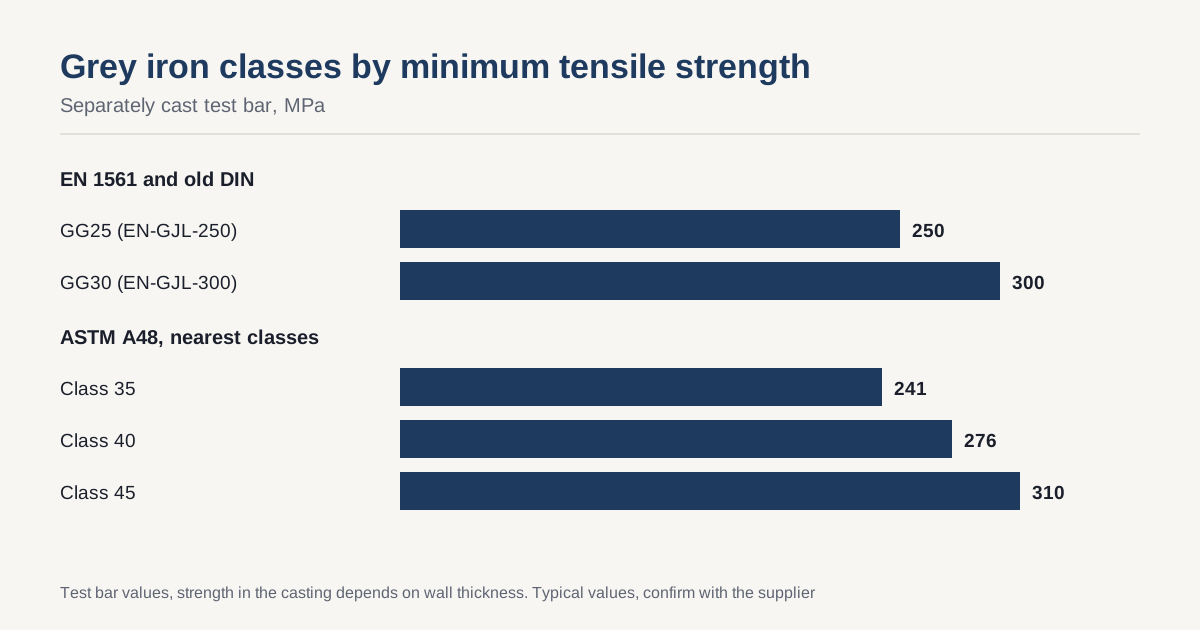
GG stands for Grauguss, grey iron, in the old German system. The number is the minimum tensile strength in MPa, measured on a separately cast test bar. So GG25 has a minimum of 250 MPa and GG30 a minimum of 300 MPa.
| System | 250 MPa class | 300 MPa class |
|---|---|---|
| Old German (DIN) | GG-25 | GG-30 |
| European (EN 1561) | EN-GJL-250 | EN-GJL-300 |
| ISO 185 | JL/250 | JL/300 |
| ASTM A48 (nearest) | Class 35 | Class 40 or 45 |
| Chinese (GB) | HT250 | HT300 |
The mapping between systems is approximate. The test bar dimensions and conditions differ, so equivalence is a matter of checking the certificates, not trusting the table.
An important detail: the tensile figure is for a test bar, usually 30 mm diameter, cast alongside the part. The strength in the casting itself depends on the local wall thickness, because thick sections cool slowly and have a coarser structure. A thick bed wall in GG25 may be well below 250 MPa in the metal.
What changes between the grades
Grey iron is iron with flake graphite. The strength depends on how much graphite there is and how fine the flakes are. Making iron stronger generally means lowering its carbon equivalent, which means less graphite and finer flakes.
| Property | Moves from GG25 to GG30 |
|---|---|
| Tensile strength | Rises |
| Modulus of elasticity | Rises slightly, remains well below steel |
| Damping capacity | Falls somewhat |
| Thermal conductivity | Falls somewhat |
| Hardness | Rises |
| Section sensitivity | Increases |
| Machinability | Slightly worse |
| Chill and shrinkage risk | Increases in thin or complex sections |
The effects are gradual, not a switch. Neither grade is poor at damping compared with steel; grey iron damps vibration several times better than a steel weldment of the same shape, which is the main reason it dominates for machine beds. The comparison is covered in cast iron versus welded steel machine bases.
The modulus of grey iron is lower than that of steel, roughly 100 to 140 GPa depending on the grade and the section, compared with about 210 GPa for steel. A cast bed therefore needs thicker walls or deeper sections to match the stiffness of a steel one, which is partly offset by its mass.
Why machine beds usually use the lower grade
A bed is limited by stiffness and vibration, not by tensile strength. Stress levels in a well-designed bed are low. The attributes a bed wants are:
- Good damping, which favours more graphite.
- Stable, uniform structure through different wall thicknesses.
- Good machinability, because the ways and mounting faces have to be cut.
- Low residual stress after casting and ageing.
GG25 gives a good balance of these. It is the usual default for general beds and columns. See machine tool natural frequency and chatter for why damping carries so much weight.
When GG30 makes sense
- Highly loaded parts such as columns carrying heavy overhung heads, where stress is a larger part of the design.
- Thin walls, where the extra strength is used to keep thickness down. In thin sections the iron cools faster and ends up stronger than the test bar suggests, though chill must be watched.
- Bearing and way surfaces that need more hardness and wear resistance.
- Parts with high local loads such as bolted joints, where the iron around the bolt takes real stress.
Where strength must go higher still, or where impact or shock loads occur, the answer is not a higher grey class but a different iron, such as nodular iron. The tradeoffs are in ductile iron versus grey cast iron machine bases.
Section thickness and the real strength
A bed has walls of different thickness, with ribs, flanges and bosses. A heavy boss near thin walls cools slowly and is soft and coarse. The thin wall cools fast and may be hard, brittle and even chilled, forming white iron that is hard to machine. A higher-strength grade with less carbon is more prone to chill in thin sections.
The foundry controls this with composition, inoculation, pouring temperature and gating. The buyer controls it by drawing a bed with fairly even sections, with generous fillets, and by asking the foundry which wall thicknesses it can hold. Defects from poor control are described in grey iron casting defects.
Ageing and stress relief
Whatever the grade, a cast bed holds residual stress from cooling. It is relieved by natural ageing, by thermal treatment or by vibration, before final machining. Skipping this leads to movement after the ways are cut. The role of relief is covered in machine base stress relief and flatness, and it applies to cast beds as it does to fabrications.
Cost
GG30 costs a little more per tonne than GG25 because of tighter composition control and more scrap risk, and the difference varies by foundry. For a bed that does not need the strength, the premium buys nothing. For parts that do, the premium is small compared with the cost of a failed casting.
Pattern and tooling costs, which often matter more for a one-off bed, are discussed in casting patterns for machine beds.
What to specify
- Designation and standard. EN-GJL-250 to EN 1561, or the grade as the foundry knows it, with the old name in brackets if needed.
- Test bar requirement. Separately cast bar, or a bar attached to the casting, with the tensile result on the certificate.
- Hardness range, if relevant for ways, measured at agreed positions.
- Microstructure, such as graphite type and the ferrite or pearlite content, where the application justifies it.
- Inspection, including visual inspection and, for critical parts, ultrasonic or other checks for internal defects.
- Ageing or stress relief, and when it occurs in the sequence.
For acceptance, ask for a chemical analysis and a tensile test report from each pour, tied to the casting by a heat or batch number.
The grade is one line of the order; the whole path from grade to accepted casting is in our guide to the cast iron machine base.
Reading a foundry certificate
A foundry certificate for grey iron should show more than the grade name. Look for the heat or pour number, the chemical analysis with carbon, silicon, manganese, phosphorus and sulphur, the tensile strength of the test bar and its diameter, and the hardness if specified. Carbon and silicon together give the carbon equivalent, which explains much of the behaviour: a higher carbon equivalent means more graphite, better damping and machinability, and lower strength. A GG25 with a carbon equivalent near the upper end of the range will damp better than one near the lower end, though both meet the grade.
Compare the certificate with the standard you named, not with the foundry’s own grade chart. If the test bar was cast separately, ask whether a bar attached to the casting is also available, since an attached bar follows the cooling of the part more closely. For a first order, a few hardness readings on the finished casting at thick and thin sections are cheap and tell you how uniform the iron is.
Checklist
- Confirm that stiffness and damping, not tensile strength, govern the bed.
- Choose GG25 as the default; move to GG30 for specific, justified reasons.
- Draw even wall thicknesses and avoid isolated heavy bosses.
- Specify the standard, test bar and hardness requirements.
- Require chemical and tensile reports per pour.
- Plan ageing before finish machining.
To have a cast bed quoted in a stated grey iron class, with the foundry’s own certificates, send the drawing through the RFQ page. We respond within 24 business hours. For background see the Wikipedia article on cast iron.
See also: grey iron classes for machine beds, with strength by wall thickness.
Common questions
What do GG25 and GG30 mean?
GG is the older German designation for grey iron, and the number is the minimum tensile strength in newton per square millimetre, measured on a separately cast test bar. GG25 is 250 MPa and GG30 is 300 MPa. The current European designations are EN-GJL-250 and EN-GJL-300 under EN 1561, and the ISO designations are ISO 185 JL/250 and JL/300.
Is GG30 better than GG25 for a machine bed?
Not automatically. A bed is mostly limited by stiffness and damping, and the higher class trades some damping and section uniformity for strength. GG25 is a common choice for general machine tool beds. GG30 is chosen for heavily loaded parts or thin sections that need more strength. The right answer depends on wall thickness and the loads in the part.
What is the nearest ASTM class?
ASTM A48 Class 35 has a minimum tensile strength of about 241 MPa and is the nearest to GG25. Class 40 at about 276 MPa and Class 45 at about 310 MPa bracket GG30. They are not identical, because test bar size and conditions differ, so compare chemistry and tensile results on the foundry certificate rather than assuming a match.
Have a base to price? Send the drawing and we match it to up to three fabricators in Vietnam. Free for buyers, answer within 24 business hours.