Granite Machine Bases: Stone Grades and Flatness Classes
What a natural granite machine base offers in damping, thermal stability and flatness, how ISO 8512-2 grades are read, what inserts and machining cost and where granite is a poor fit.
Granite is a quiet material in the machine tool world. A granite base does not rust, hold stress from welding or ring like a steel box. It is also heavy, brittle and slow to make. For measuring machines and some precision grinders and lasers it is still the best choice. For everything else it is a specialist option with real limits.
What the stone is
The dark stone used for precision bases is commonly sold as black granite, although geologists often classify it as gabbro or diabase. It is fine-grained, dense and uniform, with few visible crystals. The properties that matter vary by quarry, so a specification should name the stone and not rely on the trade term.
Typical ranges quoted for stones of this kind:
| Property | Granite base stone | Steel | Grey iron |
|---|---|---|---|
| Density | about 2.9 to 3.1 g/cm³ | about 7.85 g/cm³ | about 7.1 g/cm³ |
| Modulus of elasticity | about 50 to 100 GPa | about 210 GPa | about 100 to 140 GPa |
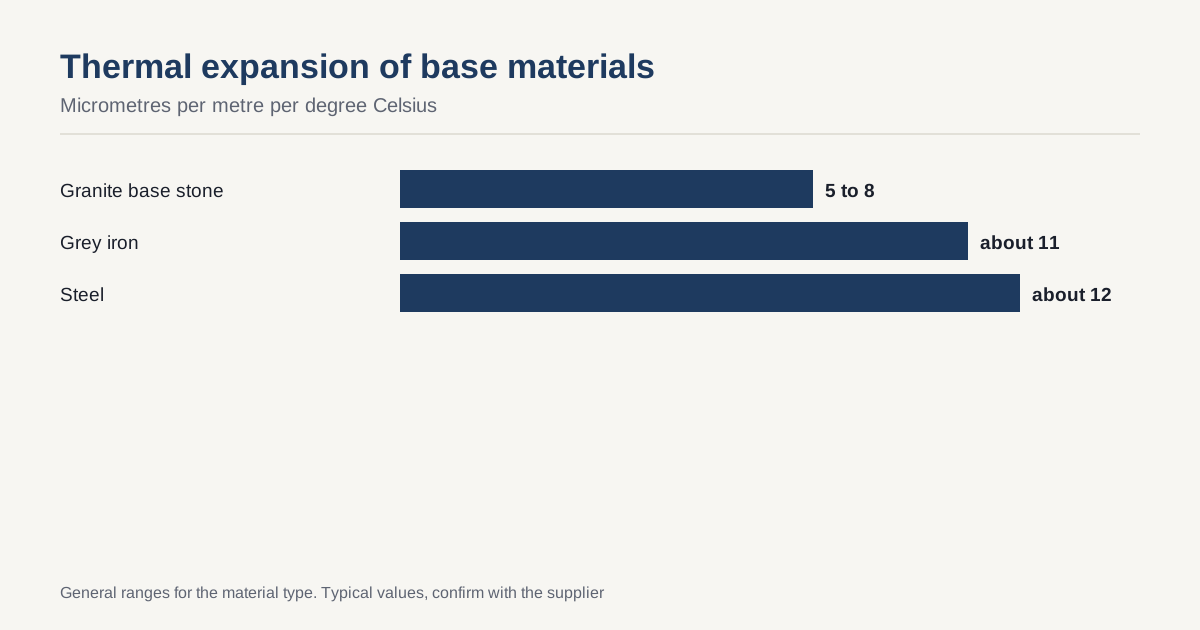
| Thermal expansion | about 5 to 8 µm/m/K | about 12 µm/m/K | about 11 µm/m/K |
| Damping | high | low | medium to high |
These are general ranges for the material type. Ask the supplier for test data on the actual stone.
The lower modulus means a granite base needs a thick, deep section to reach a given stiffness, and the low expansion means it holds its size as temperature changes. Both properties are covered for engineered alternatives in epoxy granite machine bases and polymer concrete versus cast iron.
Why it holds accuracy
- No residual stress from welding or casting, because the stone was formed slowly over geological time.
- No corrosion, so no rust to affect fit, and no paint to chip.
- Non-magnetic, which matters near sensors and magnetically sensitive equipment.
- High damping, which keeps vibration from the floor and from the machine low.
- Low thermal expansion, so a temperature swing moves the part less.
- Lappable to extreme flatness, because the grain is fine and uniform.
Reading flatness grades
ISO 8512-2 sets accuracy grades for granite surface plates. The grades are 00, 0, 1 and 2, where 00 is the tightest. The standard gives a flatness tolerance for each grade and plate size, rising with the plate’s diagonal length. Related national standards use similar grades, such as DIN 876 in Germany and ASME B89.3.7 in the United States, which labels grades AA, A and B.
| Grade | Typical use |
|---|---|
| 00 (laboratory) | Calibration rooms, reference plates |
| 0 (inspection) | Inspection tables, measuring machine bases |
| 1 (toolroom) | General layout and shop inspection |
| 2 (workshop) | Rough work and non-critical seats |
The numerical tolerance depends on the plate size and the standard, so the drawing should state the grade, the standard and the plate dimensions, not only the grade letter. A machine base is not a surface plate, but its flatness requirements are often borrowed from these grades.
Making a granite base
A granite machine base is made from a block that is sawn, ground and lapped, and then fitted with features.
- Block selection. Stone free of cracks, veins and soft spots.
- Sawing and rough grinding to size.
- Fine grinding and lapping of working surfaces to the specified grade.
- Features. Threaded inserts, holes, T-slots, V-grooves or air-bearing surfaces.
- Inspection against the grade, at controlled temperature.
Each step is slow, and the lapping step takes the most skill. Precision falls out of time spent on the surface, not out of machines alone, so a quote that seems very short on lead time deserves a question.
Inserts and attachments
A bolt cannot thread into stone. A granite base carries steel inserts, bonded into drilled holes with epoxy or a similar adhesive. They come in several forms: threaded sleeves for bolts, through holes with counterbores and T-slot inserts. Each has a rated pull-out load, and the supplier should state it.
Design points:
- Spacing and edge distance. Inserts too near an edge or each other can crack the stone.
- Insert depth. Deep enough to carry the load into the bulk of the stone.
- Thermal match. Steel inserts expand more than the stone, so the adhesive layer has to take the difference.
- Machine frames on granite. Metal columns or housings bolted to granite need a plan for the difference in expansion between the two.
Where granite does not fit
- Large, long bases. Stone blocks above several metres are costly or not available, and a joint between blocks can limit accuracy. See segmented versus monolithic machine bases.
- Heavy dynamic loads or shock, because stone is brittle and can chip or crack.
- Frames with many mounting points and complex cavities, where fabrication or casting is cheaper.
- Tight weight limits, because stone is heavy.
- Cost-sensitive volume production, where a cast or fabricated base serves.
Granite also needs careful handling in shipping, with crating that supports the stone evenly. See shipping heavy machine bases for the general approach to heavy crated goods.
Sourcing questions
- Which stone, from which quarry, with what test data?
- Which grade and standard, and what plate size does it apply to?
- Who laps the surfaces, and at what temperature are they checked?
- What are the pull-out ratings of the inserts, and how were they tested?
- How is the stone crated and supported in transit?
- What inspection report accompanies the base?
The report should state the instrument, the grid of measurement and the temperature. See measuring machine base flatness for how such measurements are made and the difference between grade-based and absolute flatness values.
Granite compared with the alternatives
A granite base is one option among several. The weldment is cheapest and most flexible. Cast iron damps well and fits large complex shapes. Polymer concrete is cast to shape, with embedded inserts and good damping, at lower cost than natural stone. Granite gives the best flatness and thermal stability for small and medium precision bases, at the highest cost per part. The wider comparison is in cast iron versus welded steel machine bases.
Environment and handling
A granite base is stable, but it is not indifferent to its surroundings. A large stone block takes a long time to reach room temperature, and a base that is warm on one side bends slightly toward the cooler side. Precision users therefore keep granite in a controlled room, away from direct sun, doors and heating outlets, and let a newly delivered base rest for a day or more before measuring it. Calibration standards for surface plates specify the reference temperature, normally 20 degrees Celsius, and flatness readings taken at other temperatures should be treated with care.
Handling is the other risk. Stone is brittle, and a corner knocked during unloading can chip and destroy a lapped edge. Lifting is done with soft slings or vacuum lifters at the points marked by the maker, and the base is supported on three points when measured, so that it does not bend under its own weight. Chips on a working surface are repaired by the maker, not by the user, and a base that arrives with damage should be photographed and reported before it is accepted.
Checklist
- Decide whether the machine needs granite’s properties or only a flat seat.
- Name the stone, the quarry and test data.
- State the grade, the standard and the plate size.
- Define inserts, their loads and positions.
- Plan the interface to steel frames, including thermal expansion.
- Specify crating and handling.
- Require an inspection report with method and temperature.
To have a precision base compared across granite, polymer concrete and fabricated alternatives, send the drawing through the RFQ page. We respond within 24 business hours. For background see the Wikipedia article on surface plates.
See also: the granite base reference: properties, flatness grades and inserts.
Common questions
Why is granite used for measuring machines and some machine tools?
It is dimensionally stable, does not rust, is non-magnetic, damps vibration well and can be lapped to a very flat surface. It also expands less with temperature than steel or iron, so it holds shape in a shop with changing temperature. These properties suit measuring machines, grinders and other precision equipment where accuracy matters more than the cost of a heavy, brittle part.
What flatness grade should I ask for?
Match it to the function. ISO 8512-2 sets grades 00, 0, 1 and 2 for granite surface plates, with 00 the tightest and the permitted deviation rising with the plate size. A measuring base often calls for grade 0 or 00; a general machine seat may need only grade 1. Choose on what the machine needs, because each step costs more lapping time.
Are all black granite bases the same stone?
No. The dark stone sold for precision bases is usually a fine-grained gabbro or diabase rather than a true granite, and properties vary by quarry, with density and modulus changing from one source to another. Ask for the stone name and quarry, and for test data on density, compressive strength and modulus, instead of accepting a generic description.
Have a base to price? Send the drawing and we match it to up to three fabricators in Vietnam. Free for buyers, answer within 24 business hours.