Hand Scraping Machine Ways: When It Still Pays Off
What hand scraping gives a machine base that grinding does not, how bearing contact is measured, what it costs in hours and when a buyer should ask for it or decline it.
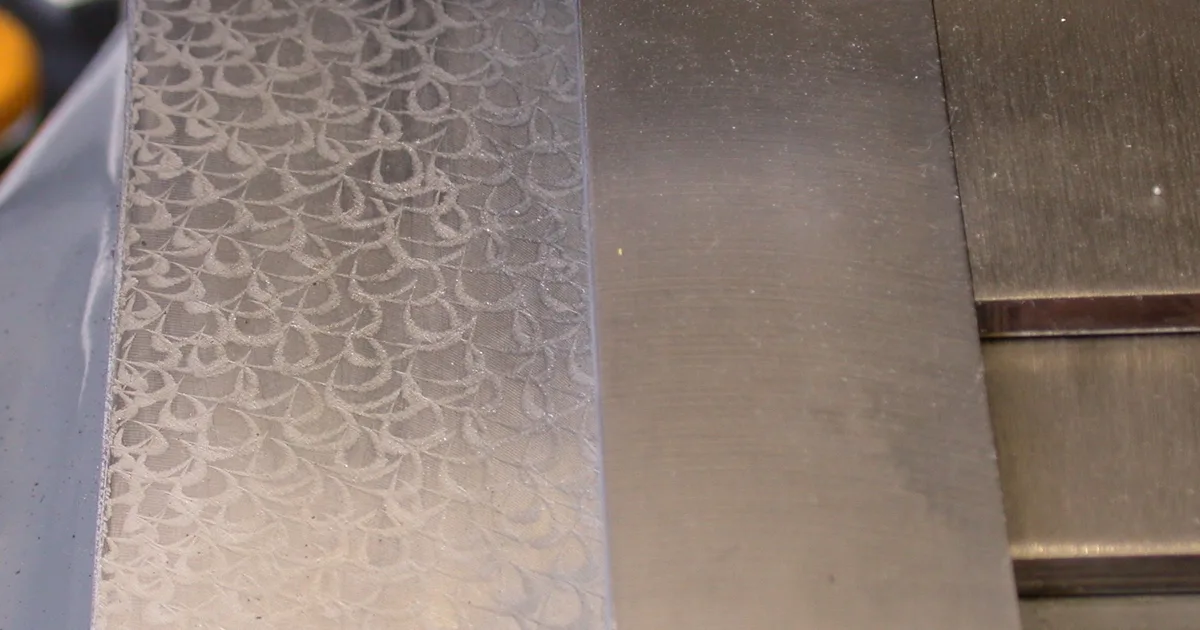
Hand scraping sounds like a trade from another century, and in one sense it is. It is also still the method behind a large share of the world’s most accurate machine tools. A buyer who orders a machine base should know what scraping does, when it is a reasonable thing to ask for and when it only adds cost.
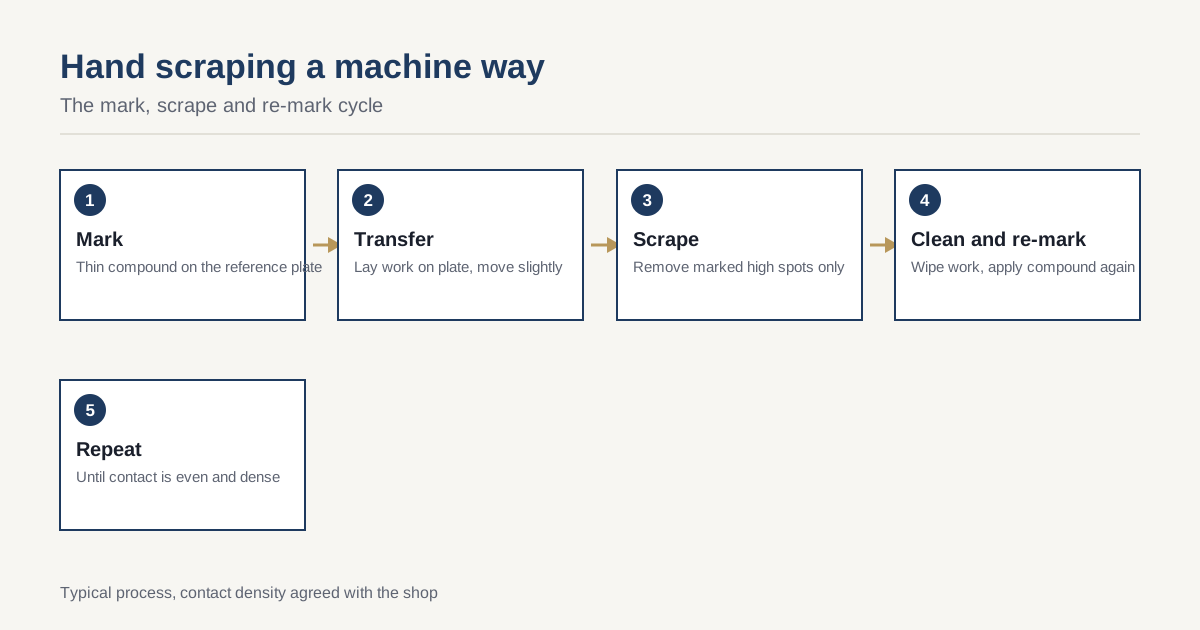
What scraping actually does
A scraper is a hand tool with a hardened, sharp edge, used to remove a very small amount of metal from the high spots of a surface. The workflow is simple:
- Apply a thin layer of marking compound to a reference surface such as a surface plate or a master straightedge.
- Lay the work against the reference and move it slightly. The compound transfers to the high spots of the work.
- Scrape the marked spots, taking only a few micrometres at a stroke.
- Clean the work, re-mark and repeat until the marks are evenly spread and dense enough.
The result is a surface that is flat to the reference and covered in many tiny contact points rather than in a continuous plane. Between the points are shallow recesses that hold oil. On a sliding way that matters: the oil film is kept in place, friction is more even, and the way resists the stick-slip behaviour that shows up on a perfectly smooth surface with a thin film.
Why not just grind
Grinding produces a flat, smooth surface faster than hand work. For most applications it is the better answer. Scraping keeps a place for four reasons.
- Fit to a mating part. A saddle scraped to its way fits the way as it is, not as the drawing says it should be. Two ground parts fit to the combined tolerance of both. A scraped pair is fitted to each other.
- Size. Very long or very heavy beds are difficult to grind in one setup. Scraping can be done where the bed stands, on its own supports.
- Correction after assembly. A way can be touched up in the machine, after the base has settled on its foundation.
- Oil retention on sliding ways. The scraped pattern holds oil on the surface.
On the other hand, grinding is better where the surface is a static seat, as for a rail, or where volume makes the hours unaffordable. See linear guide mounting surfaces for the seat case.
Measuring a scraped surface
Two measures matter, and they are independent.
Flatness and straightness. Measured as for any machined way, with precision levels, straightedges, autocollimators or a laser, and reported against a tolerance. Methods are covered in measuring machine base flatness.
Bearing contact. Judged by counting high spots inside a small frame laid on the surface, and reported as points per square inch or per 25 mm square. Machine tool texts commonly quote figures somewhere between about 10 and 20 points per square inch for sliding ways, and higher for master surfaces, though the figure depends on the machine and the maker’s practice. The number is a request to the shop, not a universal standard, so agree it in writing.
| Item | What it measures | How it is reported |
|---|---|---|
| Flatness | Deviation from a plane | micrometres over a length |
| Straightness | Deviation along a way | micrometres per metre |
| Bearing contact | Density of high spots | points per square inch or 25 mm square |
| Contact distribution | Evenness of marks | visual check, no bare patches |
Typical practice only; the contact figure should be agreed between buyer and shop.
What it costs in hours
Scraping time rises with surface area and with the contact density demanded. A narrow flat way takes a fraction of the time of a wide table surface. A large base with several ways can take many days of skilled work. A buyer asking for scraping should therefore expect to see it as a labour line on the quote, and should ask how many hours are included.
Two guidelines help control the cost:
- Ask for scraping only on the surfaces that need it. A sliding way and its mating face are candidates; a cover plate seat is not.
- Specify a reasonable contact figure. Doubling the density does far more than double the time.
For the broader picture of where machining hours go, see what a machine base costs.
Which bases are scraped
Scraping is most common on cast iron bases, where the metal is stable and the grain is suited to the work. It can be done on steel and on weldments, although a weldment must first be stress relieved and machined, or the surface will move and undo the work. The relevant steps are in stress relief and flatness.
In practice many modern machines combine methods. The base is cast or fabricated and rough machined, ways are finish ground, and scraping is used only where a fit is critical, such as a saddle on a bed or a gib against a way.
Alternatives to scraping
Builders who want the benefits without the hand hours have several options.
- Hardened and ground steel ways bolted or bonded to the base, ground to size in a machine.
- Profile rails with preload, mounted on a milled or ground seat.
- Low-friction slideway coatings applied to one of the sliding faces, which accommodate small fit errors and cut stick-slip.
- Hydrostatic ways, which need a very good surface but do not rely on contact points.
Each moves the accuracy problem to a different place. Scraping moves it to the skill of one person with a scraper.
Skills and what to check
Scraping skill is not evenly spread among fabricators. A shop that offers it should be able to show:
- A reference surface plate or master straightedge of suitable size, with a calibration record.
- Marked-up examples of previous work, with contact counts.
- The names of the people who do it, and how long they have done it.
- A realistic estimate of hours for your part.
If a shop cannot show those, the offer of scraping is probably a general claim. For a first order, ask for a trial piece or a witness inspection at the shop. The shop’s process records, along with the overall approach to checks in an inspection and test plan, are the evidence that counts.
When to ask for it and when to decline
Ask for scraping when:
- The base carries sliding ways without a rail.
- The saddle or table must be fitted to the way.
- The part is too large to grind in one setup.
- You are building a small number of machines and accuracy outweighs hours.
Decline or reduce it when:
- The surface is a static seat for rails or covers.
- Volume is high and a ground insert gives the same accuracy.
- The base has not been stress relieved, so the work would be undone.
A note on training and succession
Scraping is a craft, and the skill sits with a small number of people. A shop that offers it today may not offer it in five years if its scrapers retire, which matters for a buyer planning repeat orders or later repairs. Ask how long the scrapers have worked, whether apprentices are being trained and whether the shop can scrape on site if a way is damaged in service. Many machine tool users value exactly this: a scraped way can be repaired locally with a scraper and a plate, where a ground way needs the machine to be stripped and the part sent away.
For a first order from a new shop, a small trial piece such as a straightedge or a short bed section can show the standard of work before a large contract is placed.
Closing checklist
- Identify which surfaces are sliding ways and which are static.
- State a contact density and how it will be counted.
- State flatness and straightness targets separately.
- Confirm that stress relief comes before scraping.
- Ask for hours as a separate quote line.
- Ask for evidence of previous scraped work.
If you are specifying a bed with scraped ways and want quotes from fabricators with the skill, send the drawing through the RFQ page. We respond within 24 business hours. For a general reference on the technique, see the Wikipedia article on surface plates, the reference that scraping is measured against.
Common questions
Is hand scraping still used on new machine tools?
Yes, mainly on high-accuracy machine tools, large machines and low-volume builds. It is used to finish flat and box ways, to fit saddles and tables to their ways, and to correct small errors left after grinding. Most volume production has moved to ground ways with hardened inserts or profile rails, because machine finishing is faster and more repeatable.
How is the quality of a scraped surface measured?
Two things: flatness against a reference, and bearing contact. Contact is judged by wiping marking compound on a master surface, laying it on the work and counting the marked high spots inside a small square, usually reported as points per square inch or per 25 mm square. Flatness is checked with levels, straightedges or optical methods in the usual way.
Does scraping cost much more than grinding?
It costs more because it is labour by a skilled person, and the time grows with surface area and with the contact density requested. The cost is justified when the surface must carry sliding loads with oil retention and when the part cannot be ground in one setup. For static seats such as rail mounting faces, scraping is rarely worth the extra hours.
Have a base to price? Send the drawing and we match it to up to three fabricators in Vietnam. Free for buyers, answer within 24 business hours.