A36 or A572 Grade 50: Choosing a US Plate Spec for a Machine Base
How ASTM A36 and A572 Grade 50 differ in strength, welding and cost, why neither changes stiffness, and how to write a US plate specification a Vietnamese shop can follow.
US drawings often carry a short material note: A36 plate, or A572 Grade 50. Both are ASTM structural steels and both weld well. They differ in strength, in chemistry and in price, and for a machine base the strength difference matters less than it appears.
The two specifications
ASTM A36 is the long-standing carbon structural steel specification. ASTM A572 covers high-strength low-alloy columbium-vanadium structural steel in several grades, of which Grade 50 is the common one.
| Property | A36 | A572 Grade 50 |
|---|---|---|
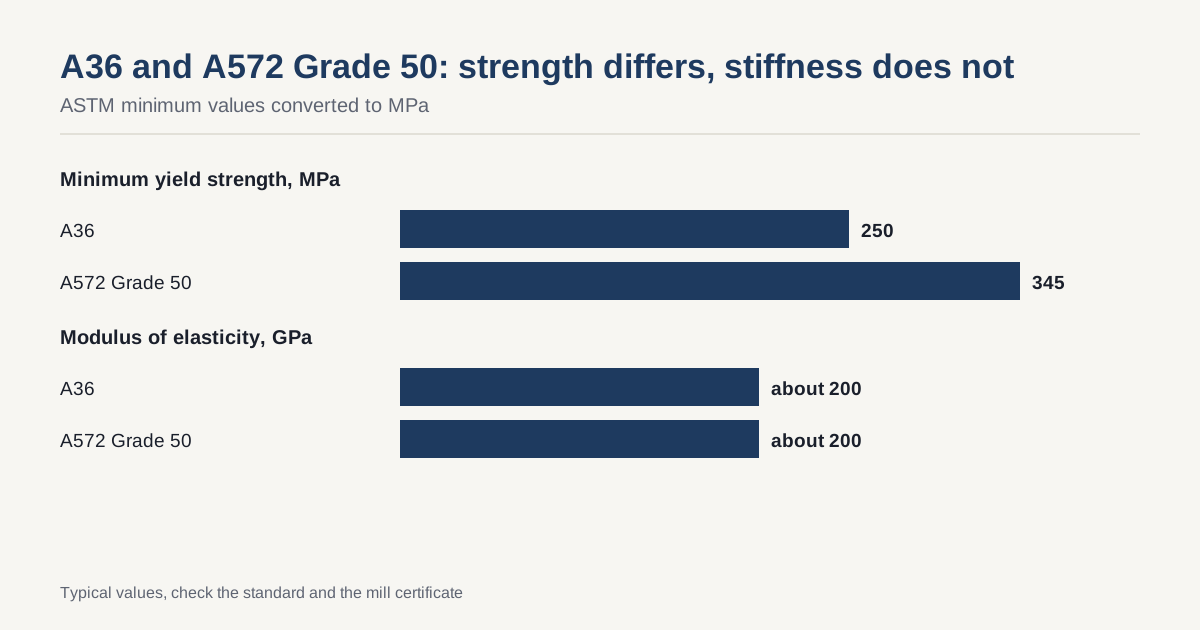
| Minimum yield strength | 36 ksi (about 250 MPa) | 50 ksi (about 345 MPa) |
| Tensile strength | 58 to 80 ksi (about 400 to 550 MPa) | 65 ksi minimum (about 450 MPa) |
| Alloying | Carbon steel | Columbium or vanadium added |
| Modulus of elasticity | about 29,000 ksi (200 GPa) | about 29,000 ksi (200 GPa) |
| Typical weld filler | E70 series low-hydrogen | E70 series low-hydrogen |
Values are the minimums and ranges commonly quoted from the specifications. Check the current edition of each standard and the mill certificate for the plate supplied.
What decides a machine base
Most machine bases are limited by stiffness, which depends on the modulus and the geometry. The modulus is the same for both steels. Moving from A36 to Grade 50 gives no more stiffness for a given thickness and layout, and a stiffness-limited base needs the same plate in both.
For that reason, many designers keep the bulk of a base in the cheaper, more available grade and reserve the stronger steel for the places where strength governs. See machine base stiffness and deflection for the case against paying for yield strength that is never used, and the matching European comparison in S355 versus S275.
Where Grade 50 earns its place
- Lifting lugs and tie-down points. They concentrate load and set a maximum on weight to be moved.
- Anchor and foundation plates, where bolt loads are high.
- Press and forming frames, where working stress is a large share of yield. See hydraulic press frames.
- Weight-critical parts, where thinner plate saves crane capacity or freight.
For anything cycling at high stress, remember that fatigue life of a welded joint depends mostly on the weld detail, not on the grade of steel. A better detail beats a stronger plate.
Welding differences
Under AWS D1.1, the structural welding code, A36 and A572 Grade 50 are both prequalified base metals, and the usual low-hydrogen E70 electrodes or equivalent wire are prequalified filler metals for both. Grade 50 has microalloying and a slightly higher carbon equivalent in many heats, so thick sections may need more careful preheat and heat control than A36. On the plate thicknesses typical of bases, both are routine.
The important point for a buyer is the welding procedure and the welder qualification. Whether the shop works to AWS D1.1, to ISO 15614-1, or to both, ask for the procedure records for the grade named on the drawing. The discussion of fabrication systems in ISO 3834 for Vietnamese fabricators applies to either code.
Residual stress and distortion
Higher yield strength lets welds lock in more residual stress, so a Grade 50 base may move slightly more at relief than the same base in A36. In practice the sequence, fixturing and stress relief carry the work, as in welding distortion control and stress relief and flatness.
Sourcing an ASTM plate overseas
This is where US buyers meet a practical issue. A Vietnamese fabricator may stock steel to JIS, EN or Chinese standards and import ASTM plate for export orders. The options are:
- True ASTM plate with mill certificate. The certificate names A36 or A572, the heat number and the test results. This is what the drawing asks for.
- Equivalent grade offered in place of ASTM. SS400 or S275 for A36, S355 for Grade 50. This needs written agreement and a comparison of chemistry and mechanical properties, as described in SS400 and Q235 equivalents.
- Dual-certified plate. Where available, it may satisfy two specifications at once.
Do not accept “equivalent” in a quote without a reference to the standard. An ASTM claim without a certificate is not enough.
Documents to ask for
- Mill test report showing heat number, chemistry and mechanical properties, and the standard it was tested to.
- Traceability from the heat number to the finished part, so that the plate in the base can be matched to the certificate.
- For plates with a stated toughness requirement, impact test results at the stated temperature.
These belong in the inspection pack in inspection test plans for machine bases. Export paperwork is covered in export documents for machinery.
Cost and tariff context
Plate price differences between A36 and Grade 50 vary by supplier and market, and for a stiffness-limited base the thickness is the same, so there is no weight saving to offset a premium. Where the plate is imported to the shop, availability and lead time can matter more than the unit price. Steel content in a finished base can also affect import duties in the destination country, which is a separate question covered in Section 232 tariffs on machine bases.
What to write on a US drawing
A complete callout looks like this in structure, with values chosen for the part:
- Standard and grade, such as ASTM A36 or ASTM A572 Grade 50.
- Product form and thickness tolerance, normally by reference to ASTM A6 for plate.
- Mill test report required.
- Welding code, such as AWS D1.1, and filler class.
- Acceptable equivalents, if any, and who approves them.
- Any toughness or special testing.
If more than one grade is acceptable, say so. A drawing that names one grade and a quote that offers another causes delay.
Choosing in practice
- Treat stiffness as the governing requirement for the bulk of the base.
- Use the grade the fabricator can supply with a full certificate, if either meets the stiffness need.
- Use Grade 50 for lugs, anchor plates and highly stressed local parts.
- Make equivalents explicit on the drawing, with approval rules.
- Ask for certificates and traceability.
A worked example
Take a welded base for a mid-size machining centre, designed for stiffness with 20 mm walls and 25 mm top plate. The designer checks the lifting lugs, which carry the full weight of the base on four points. Each lug sees a load several times larger per square millimetre than any wall in the structure. In A36 the lug plate might need to be 40 mm thick. In Grade 50 the same lug can be about 30 mm, because the allowable stress rises with yield strength. The walls stay at 20 mm in both cases, since stiffness fixed that figure.
The sensible outcome is a mixed specification: A36 for the bulk plate, which is cheap and widely stocked, and Grade 50 for the lugs and anchor plates, which are few and small. The extra cost is the premium on a small weight of steel, and the saving is a lighter, smaller lug. Mixing grades is allowed as long as each plate is identified and the welding procedure covers both. Put the grade on every part number in the bill of materials so that the shop cannot swap one for the other at the saw.
Closing checklist
- Is the plate grade on the drawing complete, with standard and certificate requirement?
- Does the welding procedure cover the grade and thickness?
- Have equivalents been agreed in writing?
- Is the high-strength grade used only where strength governs?
- Do mill certificates match the heat numbers on the plate?
To get a base quoted to an ASTM specification, with or without offered equivalents, send the drawing through the RFQ page. We respond within 24 business hours. For background see the Wikipedia article on ASTM A36 steel.
Common questions
Is A572 Grade 50 better than A36 for a machine base?
Only where strength governs. Grade 50 has a higher minimum yield strength, so it carries more stress before yielding, but its modulus of elasticity is the same as A36, so a base that is too flexible stays too flexible. For a stiffness-limited base the choice is mostly about what is available and what it costs. For lugs, anchor plates and other highly stressed parts Grade 50 can save thickness.
What European or Asian grade matches A36?
There is no exact match, because the standards set different limits. A36 has a minimum yield of 36 ksi, about 250 MPa, which sits between S235 and S275 in the European system. A572 Grade 50 at 50 ksi, about 345 MPa, is close to S355. Treat these as nearest equivalents only, and compare the mill certificate against the ASTM requirements before accepting a substitute.
Can one plate meet both A36 and A572 Grade 50?
Sometimes. A steel that meets Grade 50 yield and tensile can also satisfy A36 limits, and mills sometimes certify both on one test certificate, often called dual certification. It is more common for shapes than for plate. If you want it, ask the fabricator whether the certificate covers both specifications, and state on the drawing that either is acceptable.
Have a base to price? Send the drawing and we match it to up to three fabricators in Vietnam. Free for buyers, answer within 24 business hours.