Grinding Machine Bases: Damping and Thermal Stability Rules
What a grinder base has to do differently from a milling base: damp wheel and floor vibration, hold temperature, carry coolant. Material choices, layout rules and what to specify.
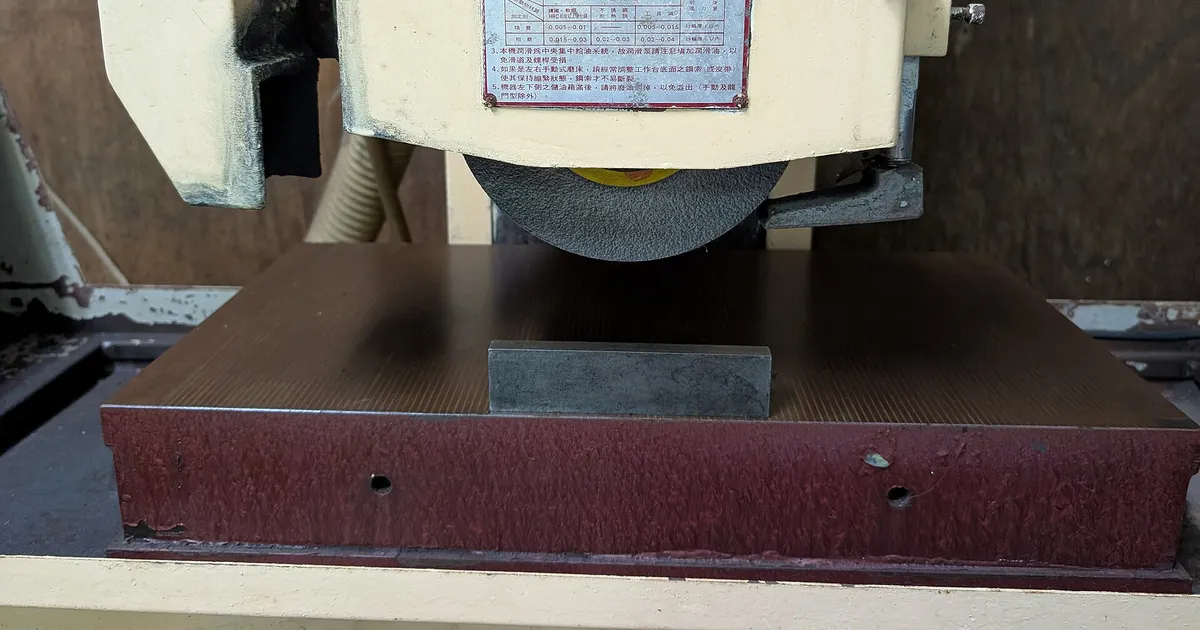
A grinding machine is where the precision of a machine tool is most exposed. A milling machine cuts parts to hundredths of a millimetre. A grinder is asked for micrometres, and for a surface so smooth that vibration of a fraction of a micrometre leaves visible marks. The base of such a machine does a harder job than the base of a milling machine of the same size.
What a grinder base has to do
- Hold geometry under the weight of the machine and the grinding forces, as any base does.
- Damp vibration from the wheel, the spindle and the drives.
- Isolate floor vibration from nearby machines, trucks and the building.
- Stay thermally stable while heat sources change.
- Carry coolant without leaks, corrosion or temperature swings.
The first is common to all bases. The next three are why grinders get special treatment.
Vibration sources
A grinder meets several sources of vibration.
- Wheel imbalance. A grinding wheel rotating at high speed exerts a force that rotates with it if it is not balanced. The wheel is balanced on its flange, and often again during dressing. The base must not amplify the frequency of rotation.
- Spindle bearing noise.
- Hydraulic pump pulsation, where used.
- Floor vibration from other equipment.
- Self-excited vibration, or chatter, where the cut itself feeds energy into a resonance. In grinding it can come from the wheel and from the workpiece. See machine tool natural frequency and chatter for how chatter develops.
A base with high damping lowers all of these. A base with natural frequencies near the wheel speed makes them worse.
Materials for grinder bases
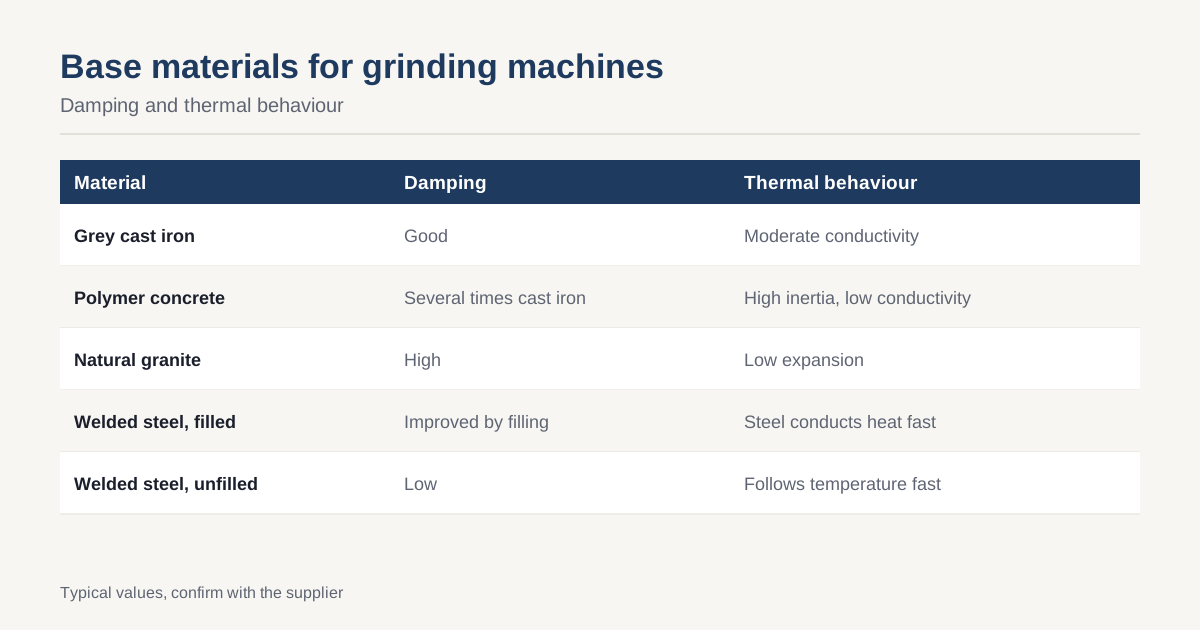
| Material | Damping | Thermal behaviour | Notes |
|---|---|---|---|
| Grey cast iron | Good | Moderate thermal conductivity | Traditional choice, suits large complex shapes |
| Polymer concrete (mineral casting) | Several times that of cast iron | High thermal inertia, low conductivity | Common for precision grinders, cast to shape with inserts |
| Natural granite | High | Low expansion | Excellent for small and medium precision machines |
| Welded steel, filled | Improved by filling | Steel conducts heat quickly | Cheaper for low volume, damping depends on filling |
| Welded steel, unfilled | Low | Follows temperature fast | Rarely used for precision grinders without treatment |
Comparisons are typical of the material type; actual values depend on the design. The materials are discussed in more detail in epoxy granite machine bases, polymer concrete versus cast iron and granite machine bases.
A fabricated steel base filled with concrete or grout, as in concrete-filled machine bases, is a middle route that raises damping and mass at moderate cost.
Thermal rules
Thermal growth is a main source of error in grinding. The rules designers use are simple.
- Symmetry. Make the structure symmetric about the wheel axis, so uniform heating causes growth, not bending.
- Separate the heat sources. Place motors, hydraulic units and coolant tanks outside the main structure, or insulate them.
- Control coolant temperature. A chiller that holds coolant within a fraction of a degree stops it acting as a heat source or sink.
- Use thermal mass. A large, massive base responds slowly to room temperature swings.
- Warm up the machine. Run it for a stated period before precision work, so it reaches a steady state.
- Measure and compensate where the control allows.
For steel, expansion is about 12 micrometres per metre per degree Celsius, a handbook figure, so a metre-scale structure with a one-degree difference between top and bottom moves by amounts that matter against micrometre tolerances.
Floor isolation
A grinder is often mounted on isolators. Pneumatic or elastomer mounts lower the natural frequency of the machine on its supports, so that floor vibration above that frequency is attenuated. The base has to be rigid enough that the machine moves as one body on the mounts, since a flexible base mounted on springs can resonate within itself.
For the heaviest and most precise machines the answer is a separate foundation block, isolated from the building slab by a gap, with the machine grouted to it. See machine base levelling and grouting for how levelling and grouting hold the base.
Layout rules for the base
- Low centre of gravity and a wide footprint.
- Short load paths between wheel and work, so that the loop of structure which closes the force is small and stiff.
- A closed-section structure with ribs, as in machine base rib design.
- Coolant trays and drains designed into the base, with slopes and sealed edges, so coolant never pools on the structure.
- Corrosion protection where coolant contacts the base: coatings, or materials that do not rust.
- Mounting for hydrostatic or hardened ways with flatness targets tied to the guideway choice, covered in linear guide mounting surfaces.
Specifying for a grinder base
A drawing and RFQ for a grinding machine base should add to the usual points:
- The target for first natural frequency and the frequency range of concern, such as wheel speed.
- Damping requirement, or the material and filling expected.
- Thermal symmetry and heat source locations.
- Coolant containment and surface protection.
- Flatness, straightness and parallelism targets in micrometres, with measurement temperature.
- Mounting concept: isolators, chocks or grouted foundation.
The first natural frequency and its calculation are typically checked in finite element analysis, as in FEA for machine base design. Ask the fabricator whether the supplied design has been analysed, or whether the customer’s analysis is to be followed.
Where fabricators fit
Welded and filled bases suit lower-volume grinders and large machines where casting or mineral casting is uneconomic. For these, ask about stress relief and the filling method, because a filled steel base that moves after relief defeats the purpose. The working sequence is in machine base stress relief and flatness.
A short case for filled bases
Fabricated bases for grinders are common where volume is low, and the question is how to bring damping up to the level of cast iron or mineral casting. Two measures work. The first is filling closed sections with a material that dissipates energy, such as polymer concrete, sand or a grout, bonded to the walls so that the interface also rubs and absorbs vibration. The second is adding mass low in the structure, which lowers the centre of gravity and the natural frequency of the machine on its mounts, moving resonances away from the wheel speed.
There are cautions. Filling adds weight, which the foundation and shipping must handle. Sand or loose fill can settle and leave voids, while a bonded fill needs a vent and a plan for curing. Steel walls that carry a filler still conduct heat quickly, so thermal control by symmetry and coolant temperature remains necessary. Finally, the base must be stress relieved before the fill goes in, because the filled part cannot be relieved afterwards without damaging the filler.
Ask the fabricator which of these steps are in the quote and which would be added by the machine builder.
A final practical point concerns acceptance. Ask the fabricator to record the flatness of the machined mounting faces at a stated temperature, and keep that record with the base. When the grinder is later assembled, any drift between the factory figures and the installed figures points to a handling or foundation problem, not to the base, and the record saves a long argument between the parties.
Checklist
- Identify the vibration sources, including wheel speed.
- Choose a material for damping and thermal behaviour.
- Keep the structure symmetric and the heat sources separate.
- Design coolant control and containment into the base.
- Plan isolation: mounts or a separate foundation.
- State flatness and thermal test conditions.
- Check the first natural frequency against wheel speed.
To have a grinder base quoted in fabricated, filled or cast form, send the drawing through the RFQ page. We respond within 24 business hours. For background see the Wikipedia article on grinding machines.
Common questions
Why do grinding machines need such quiet bases?
Because the finish and size they produce are at the micrometre level, and any vibration between wheel and workpiece shows up on the surface as waviness or chatter marks. A milling base can tolerate some vibration since the cutter is rough and the tolerance larger. A grinding base has to damp wheel imbalance and isolate floor vibration as well as hold geometry.
Is mineral casting common for grinder beds?
Yes. Polymer concrete, also called mineral casting or epoxy granite, is widely used for grinding machine beds because it damps vibration several times better than cast iron and has good thermal inertia. It is cast to shape with embedded inserts and fitted with hardened rails. Cast iron remains common too, particularly for large grinders and where proven designs exist.
How does temperature affect a grinder base?
A grinder generates heat from the wheel, the spindle, the hydraulics and the coolant, and a base that warms unevenly distorts. Because tolerances are so small, a degree of difference across the base can move the wheel measurably relative to the work. Designers keep the structure symmetric, control coolant temperature and let the machine stabilise before cutting precision parts.
Have a base to price? Send the drawing and we match it to up to three fabricators in Vietnam. Free for buyers, answer within 24 business hours.